
The Union Public Service Commission (UPSC) has officially released the notification for the Civil Services Examination (CSE) 2026, and the magic number is 933.
While 933 vacancies across prestigious services like the IAS, IPS, and IFS might seem like a substantial window of opportunity, a closer look at the data reveals a different story. Compared to the 1,000+ vacancies seen in the last two cycles, 2026 presents a tighter squeeze. At Kuniya IAS Academy, we believe this isn’t a cause for alarm, but a call for a smarter, more surgical strategy.
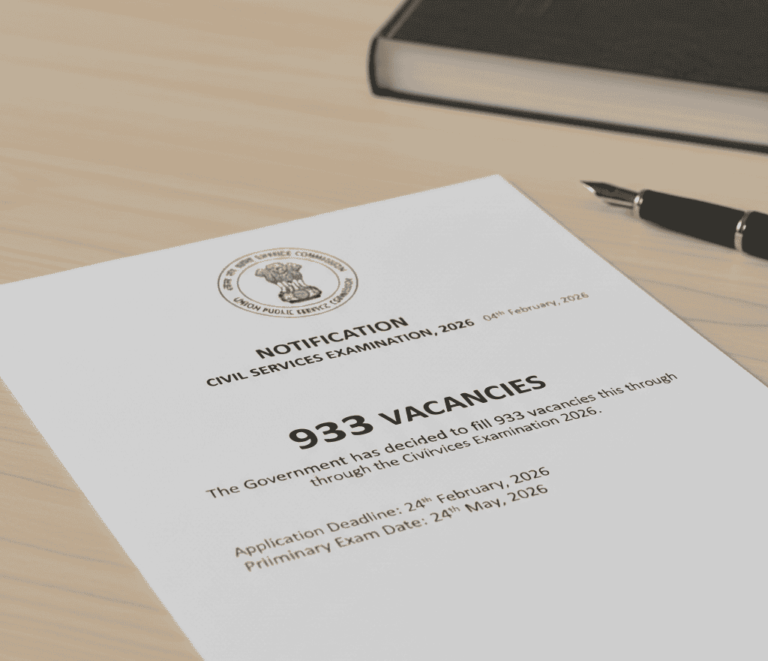
The Reality of 933: Competition is Peaking
In the world of UPSC, numbers are relative. With nearly 10 to 13 lakh aspirants applying every year, 933 seats mean the success ratio remains well below 0.01%.
The reduction in seats typically leads to:
- Higher Cut-offs: A smaller pool for the Mains means the Preliminary Exam becomes even more of a “rejection” stage than a selection stage.
- Narrower Margins: In the Final Merit List, a single mark can be the difference between getting your preferred service (IAS) and being left out of the list entirely.
To navigate this, beginners must start with a rock-solid foundation. If you are just starting your journey, check out our guide on IAS preparation strategy for beginners to ensure you don’t waste precious time on the wrong resources.
Why You Need a “Smarter Strategy” for 2026
1. Master the “Pre-Mains” Integration
With 933 seats, you cannot afford to wait for the Prelims result to start your Mains preparation. Your strategy must be integrated. You should be “Mains-ready” by January 2026, leaving the final months exclusively for Prelims-specific facts and mock tests. This is the philosophy behind our Prelims-cum-Mains Integrated Batch, where we bridge the gap between objective knowledge and analytical writing.
2. The CSAT Hurdle
In recent years, the Civil Services Aptitude Test (CSAT) has become the silent killer of dreams. Even candidates scoring 110+ in GS Paper I are failing to qualify for the CSAT. A “smarter strategy” involves identifying your weak areas in Quant and Logical Reasoning early.
3. Data-Driven Revision
Don’t just read; analyze. Use Previous Year Questions (PYQs) to identify “High Yield Topics.” For instance, Environment and Science & Tech often carry more weight than traditional History in the Prelims. Using resources like the Press Information Bureau (PIB) can give you the edge in Current Affairs that standard magazines might miss.
The Role of Mentorship
When seats are limited, personalized feedback becomes your greatest asset. Knowing what not to study is often more important than knowing what to study. At Kuniya, our mentorship-driven coaching in Kerala focuses on individual answer-writing patterns and mental resilience—factors that determine success when the competition is this fierce.
For a deeper dive into the changing patterns of the exam, we recommend reading the detailed Civil Services Examination Overview by PRS Legislative Research, which discusses the evolving nature of bureaucracy and recruitment.
Final Thoughts
933 is not just a number; it’s a challenge. It demands that you move away from “hard work” alone and embrace “strategic work.” The 2026 cycle will reward those who are disciplined, data-driven, and ready to adapt.
Are you ready to claim one of those 933 seats? Let’s build your winning strategy together at Kuniya IAS Academy.