
Preparing for the UPSC Civil Services Examination (CSE) is often compared to running a marathon, but for the 2026 aspirant, it’s more like an expedition. You have time on your side, but without a roadmap, it’s easy to get lost in the “information overload” of current affairs or the “never-ending” depth of static subjects.
The secret to success isn’t choosing one over the other—it’s integration. Here is your definitive guide to balancing the two during your first year of preparation.
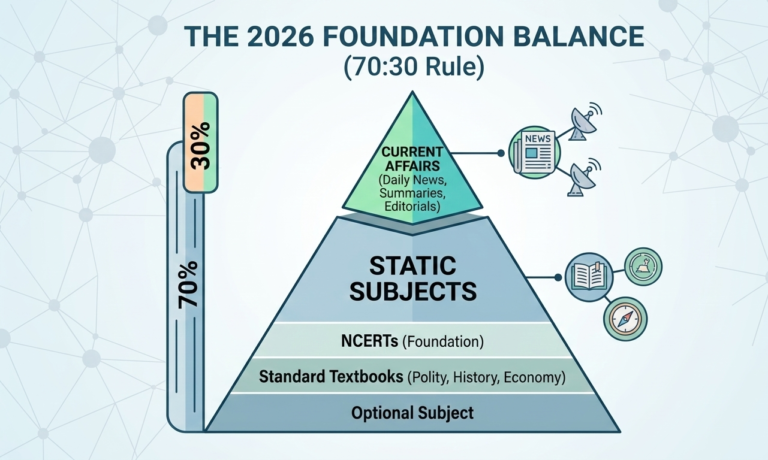
1. The 70:30 Rule for Beginners
In your first year (the foundation phase), your brain is a sponge. If you dive 100% into current affairs without knowing the static background, news reports will feel like reading a book from the middle.
- 70% Static Subjects: Focus on NCERTs and standard textbooks. You cannot understand a “Repo Rate” cut by the RBI if you don’t understand the basics of Banking and Monetary Policy.
- 30% Current Affairs: Limit your news intake to 1–1.5 hours daily. This builds the habit without burning you out.
2. Master the “Static-Dynamic” Bridge
The UPSC rarely asks a purely static question or a purely factual current affairs question. They look for the context.
- Example: If there is news about a Governor’s role in a state, don’t just read the news snippet. Go back to your Laxmikanth Polity notes and read the Constitutional provisions for the Governor (Articles 153-162).
The Strategy: Every time you read a news headline, ask: “Which part of the UPSC Syllabus does this touch?”
3. The Daily Routine: A Sample Blueprint
To maintain balance, your day should be segmented. A structured routine prevents “Guilt Prep”—the feeling that you’re ignoring one subject for another.
Time Slot | Activity | Focus |
Morning (2 hrs) | Newspaper Reading | The Hindu or Indian Express. Focus on Editorials. |
Mid-day (4 hrs) | Core Static Subject | History, Geography, or Polity (Focus on NCERTs first). |
Evening (2 hrs) | Optional Subject/Revision | Start exploring your Optional Subject early. |
Night (1 hr) | Daily Quiz/Current Affairs Summary | Use the Kuniya IAS Daily News Analysis to fill gaps. |
4. Don’t Collect Materials; Curate Them
The biggest trap for UPSC 2026 aspirants is “Resource Hoarding.”
- External Resource: For high-quality, unbiased global perspectives, refer to the Press Information Bureau (PIB) and PRS Legislative Research for policy breakdowns.
- Internal Tip: Check out our Monthly Current Affairs Magazine which categorizes news specifically into GS Paper I, II, III, and IV.
5. The Role of Answer Writing
In your first year, don’t worry about “perfect” answers. Start by linking a static concept to a current event in 150 words.
- Static: What is the Importance of the Monsoon?
- Current: How did El Niño affect India’s 2024 crop yield?
Combining these two in an answer is what the examiners call “Multi-dimensional thinking.”
6. Monthly Revision Cycles
Current affairs have a short shelf-life in memory.
- Weekly: Every Sunday, stop reading new things. Revise the week’s static chapters and news notes.
- Monthly: At the end of the month, take a Mock Test. This will show you if you are actually able to apply your static knowledge to the current questions.
Final Thoughts
For UPSC 2026, your first year is about building the “Skeleton” (Static) and then adding the “Flesh” (Current Affairs). If the skeleton is weak, the body won’t stand.
At Kuniya IAS Academy, we help you bridge this gap with mentored learning and integrated batches.
Ready to start your journey?
Contact our counselors today to get a personalized study plan for 2026!